
The intensity was measured 7 on the Japanese scale -- which ranges from zero to seven -- on the Noto Peninsula, Ishikawa Prefecture, according to NHK.

Heavy rains continued to pound Chennai and nearby districts on Monday under the impact of a cyclonic storm, which is likely to cross the coast in Andhra Pradesh on December 5.

After churning across the Arabian Sea for more than 10 days, Biparjoy made landfall near Jakhau Port in Gujarat on Thursday.

The health minister said the Centre has taken timely measures ahead of the summer season to address heatwave-related illnesses.

Nepal, which is reeling under Saturday's earthquake, is likely to experience widespread rains and thundershowers which may trigger landslides, according to the weather department which has asked people to remain alert.

The southern districts of West Bengal, including Kolkata, woke up to light rain and an overcast sky on Monday as cyclone 'Sitrang' moved towards north Bay of Bengal, raising the likelihood of a downpour during the day and threatening to dampen Diwali festivities.
The system, which moved towards Bangladesh from north Bay of Bengal at a speed of 56 kmph caused moderate to heavy rain and squally weather in West Bengal's coastal districts of South 24 Parganas, North 24 Parganas and Purba Medinipur, dampening festive spirits on Deepavali and Kali Puja.

Deficient rains can shave 50-80 basis points off gross domestic product and hurt consumption.
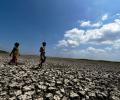
The onset of the southwest monsoon is being keenly watched this year as it may provide an early sign regarding its progress over the Indian subcontinent, particularly when El Nio is expected to rear its head during the latter half of the season.

The avalanche hit the arterial Jawaharlal Nehru Marg, which connects Gangtok to Nathu La at the China border, around 11.30 am, trapping five-six vehicles with around 30 people under the snow, the Army said in a statement.

Jalore, Sirohi, Pali and Barmer districts are the most affected and facing flood-like situations, the official said.

The IMD defines a normal monsoon as one which delivers between 96 and 104 per cent of the 50-year average rainfall for the season.
IMD Director General Mrutyunjay Mohapatra said that inducing artificial rain can only be attempted when there are clouds or moisture available.

According to the IMD, a rain event is categorised as a cloudburst if a weather station receives 100 mm of rain in one hour.

Strong crosswinds and heavy rains with thunder and lightning impacted flight operations from 4.05 pm to 4.51 pm, an airport official said.

Finance Minister Nirmala Sitharaman will set a record by presenting the sixth Budget in a row -- 5 annual Budgets and one interim -- a feat achieved so far only by former Prime Minister Morarji Desai. With the presentation of interim Budget on February 1, Sitharaman will surpass the records of her predecessors like Manmohan Singh, Arun Jaitley, P Chidambaram, and Yashwant Sinha, who had presented five budgets in a row. Desai, as Finance Minister, had presented five annual Budgets and one interim Budget between 1959-1964. The interim Budget 2024-25 to be presented by Sitharaman on February 1, will be a vote-on-account that will give the government authority to spend certain sums of money till a new government comes to office after the April-May general elections.

The IMD has predicted moderate showers in Mumbai on Tuesday and high intensity rains in neighbouring Raigad.

Floodwaters of the overflowing Yamuna reached the entrance of the Supreme Court in Central Delhi on Friday as the regulator of the Delhi irrigation and flood control department at Indraprastha suffered damage on Thursday evening.

While the city received some showers late Wednesday night, it remained almost dry on Thursday.

Meanwhile, Chief Medical Superintendent (CMS) of the district hospital, Dr Divakar Singh, was removed and sent to Azamgarh, allegedly after he made a careless remark about the cause of deaths.

On day three after a flash flood wreaked havoc in Sikkim's Teesta basin, the number of bodies recovered from the river and mud embankments downstream rose to 22, including seven army men.

Many years during which monsoons were poor saw high returns, while normal or excess rainfall has also coincided with poor calendar year gains.

The pilgrimage to Kedarnath was suspended on Wednesday for three days in view of the weather department's warning of heavy rains in the area and frequent blockage of roads to the Himalayan shrine following intermittent showers in the valley over the past few days.

Data spanning the years 1951 to 2014 show that temperature and pressure conditions at specific locations in the Arctic region during the pre-monsoon period correlate with the Indian summer monsoon rainfall, points out Charu Bahri.
With the monsoon continuing its northward advance, the weather department is expecting its onset in Delhi within the next five days.

Eleven more patients admitted at Uttar Pradesh's Ballia district hospital have died due to various ailments on Monday, taking the death toll to 68 in five days, officials said.
The flight, which was scheduled to leave at 5.40 pm, left at about 9.30 pm.

Nine more people have died as heavy rains lashed Uttar Pradesh for the third day, taking the death toll to 28, while a red alert has been sounded on Tuesday in six districts including the worst-hit Barabanki and Gonda.

ISRO made efforts to re-establish communication with rover Pragyan and lander Vikram after they were put into sleep mode in September following the onset of night on the moon.

Heavy rains have battered Himachal Pradesh since Sunday, triggering landslides in Shimla's Summer Hill, Krishna Nagar and Fagli.

"Conditions are favourable for the onset of southwest monsoon over Kerala and its further advance into some more parts of south Arabian sea, remaining parts of Maldives - Comorin area, some parts of Tamil Nadu and some more parts of Bay of Bengal during the next 24 hours," said a statement by the Indian Meteorological Department.

The Directorate General of Civil Aviation has ordered a probe into the incident.
But the IMD said the heat wave will continue till then in parts of the country.
"Conditions are favourable for dust storms over Delhi and nearby areas. We are expecting a fall in temperatures," Dr R D Singh of the Indian Meteorology Department said.

Dense fog shrouded the national capital on Tuesday morning, leading to cancellation of two flights and delaying 10 other flights and 55 trains.

A blinding layer of dense fog over north India, including Delhi, caused major inconvenience to commuters. The visibility levels were 50 metres around 5:30 am.

The southwest monsoon might finally start withdrawing from parts of North-West India over the next three days, signaling the end of its four-month journey over the country that started in June, the India Meteorological Department (IMD) said. However, though the retreat might begin from next week, the rains might not descend quickly, as the met department predicted fresh spells of rains in Vidarbha, Chhattisgarh and east MP on September 21-22 and over Odisha, Coastal areas north Andhra Pradesh and Gangetic West Bengal on September 19-21. "Due to anti-cyclonic flows over northwest India at lower tropospheric levels, dry weather is very likely over west Rajasthan, Punjab, Haryana, Chandigarh and Delhi during the next five days. "Hence conditions are becoming favourable for the withdrawal of Southwest Monsoon from parts of northwest India during next three days," the IMD said.

Conditions were becoming favourable for further advance of the southwest monsoon over some more parts of the south peninsula and east India and adjoining areas between June 18 and 21.

In the current scenario, form in the IPL will carry a lot of weight for selection in the Indian team bound for USA and Caribbean.
